Skip to content
OpenPlate

Rights clearance desk for images

A painting can be out of copyright and thephotograph of it can still be protected.

Museums publish two different things about the same artwork: whether the work is in copyright, and whether their picture of it is. OpenPlate reads both, does the arithmetic on the published term, and shows you the sentence behind every point of the score.

Where this page got its records

  • The Metlive

    391 ms. The Metropolitan Museum of Art, Collection API (Open Access)

  • Clevelandlive

    401 ms. The Cleveland Museum of Art, Open Access API

Your defaults

United States, editorial use, 10,000 reach.

Change on the terms page

2 of 2 providers answered live. 987 matching records exist across the two collections.
Results for "Anthology of Japanese and Chinese Poems"12 records

Institutions answered newest-first by record, interleaved

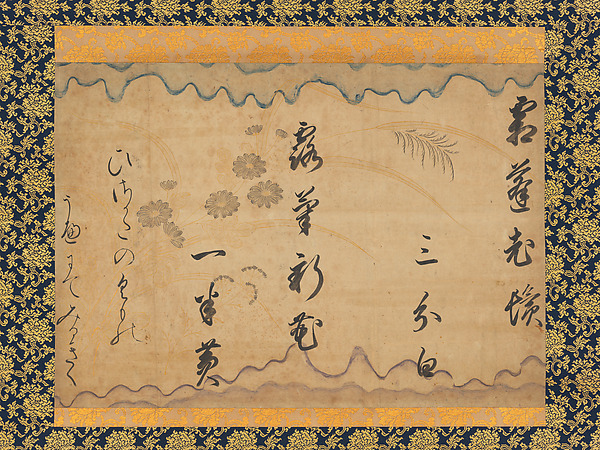
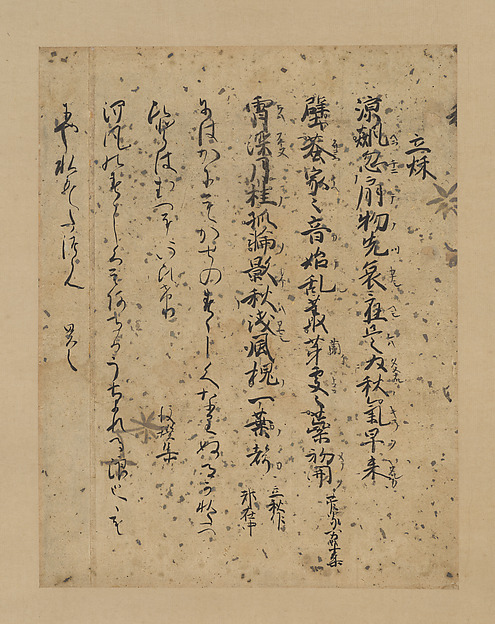
Poems about the Arrival of Autumn, from Newly Selected Collection of Poems to Sing (Shinsen rōeishū), one of the “Yamana Fragments” (Yamana-gire) by Fujiwara no Mototoshi, The Metropolitan Museum of Art

Poems about the Arrival of Autumn, from Newly Selected Collection of Poems to Sing (Shinsen rōeishū), one of the “Yamana Fragments” (Yamana-gire)

Fujiwara no Mototoshi (d. 1142)

ca. 1116–22 · Hanging scroll; ink on paper with gold and silver flecks

Cleared · Public Domain

live
The MetSimilar
Selections from the New Collection of Japanese Poems from Ancient and Modern Times (Shinkokin wakashū) with Printed Designs of Chinese Lions and Crab Finger Grass by Hon'ami Kōetsu, The Cleveland Museum of Art

Selections from the New Collection of Japanese Poems from Ancient and Modern Times (Shinkokin wakashū) with Printed Designs of Chinese Lions and Crab Finger Grass

Hon'ami Kōetsu (d. 1637)

early 1600s · Calligraphy, handscroll; ink, gold, and silver on paper

Cleared · CC0

live
Cleveland Museum of ArtSimilar
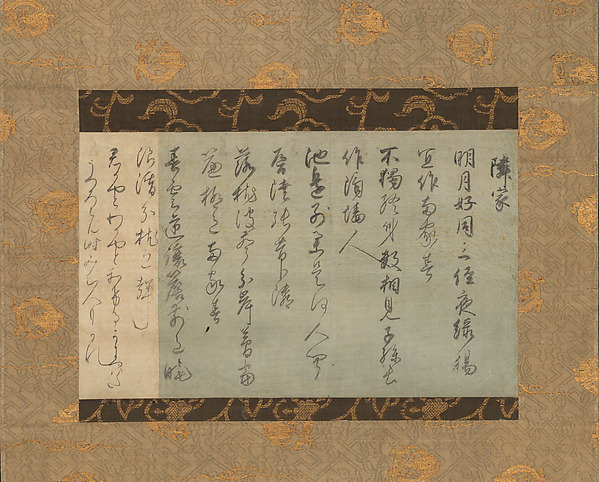
Poems about Neighbors, from Japanese and Chinese Poems to Sing (Wakan rōeishū), one of the “Tatsuta Fragments” (Tatsuta-gire) by Minamoto Ienaga, The Metropolitan Museum of Art

Poems about Neighbors, from Japanese and Chinese Poems to Sing (Wakan rōeishū), one of the “Tatsuta Fragments” (Tatsuta-gire)

Minamoto Ienaga (d. 1234)

13th century · Hanging scroll; ink on decorated paper

Cleared · Public Domain

live
The MetSimilar
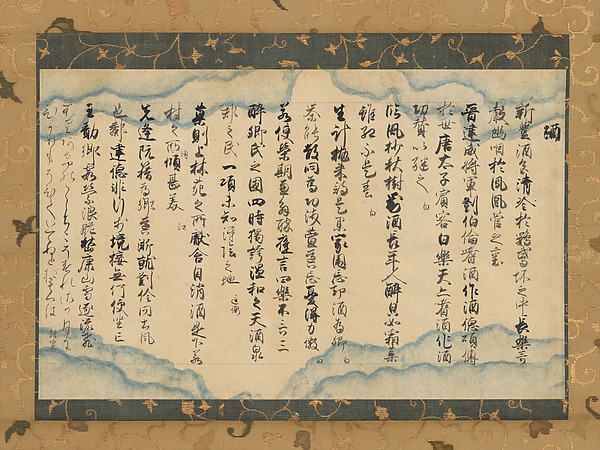
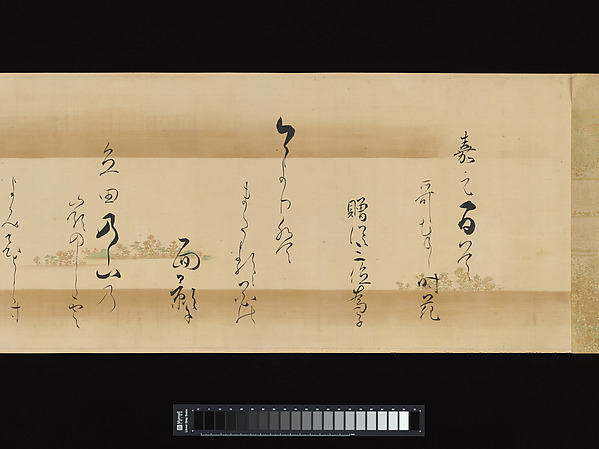
Poems from the “Cloud-Patterned Paper” version of Japanese and Chinese Poems to Sing (Kumogami-bon Wakan rōeishū) by Monk Jakuren, The Metropolitan Museum of Art

Poems from the “Cloud-Patterned Paper” version of Japanese and Chinese Poems to Sing (Kumogami-bon Wakan rōeishū)

Monk Jakuren (d. 1202)

13th century · Section of a handscroll mounted as a hanging scroll; ink on indigo dyed paper

Cleared · Public Domain

live
The MetSimilar
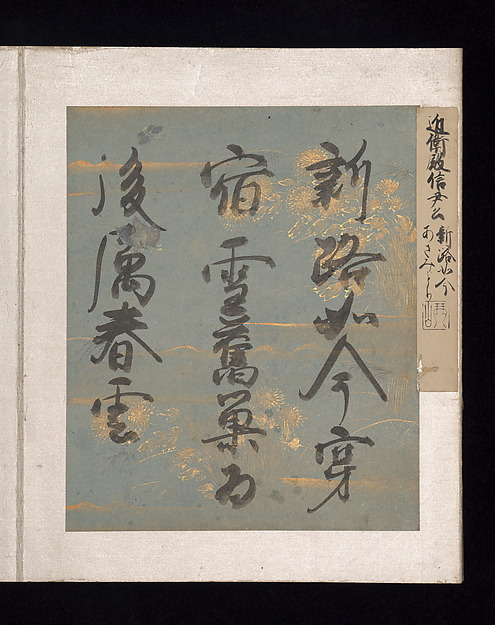
Album of Japanese and Chinese Poems to Sing by Konoe Nobutada, The Metropolitan Museum of Art

Album of Japanese and Chinese Poems to Sing

Konoe Nobutada (d. 1614)

early 17th century · Album of thirty-six leaves; each on gold, silver, or colored decorated paper

Cleared · Public Domain

live
The MetSimilar
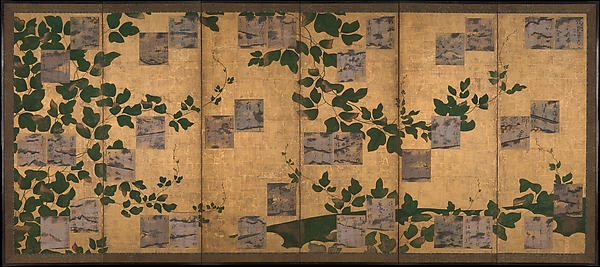
Anthology of Japanese and Chinese Poems (Wakan rōeishū) with Underpainting of Arrowroot Vines by Konoe Nobuhiro, The Metropolitan Museum of Art

Anthology of Japanese and Chinese Poems (Wakan rōeishū) with Underpainting of Arrowroot Vines

Konoe Nobuhiro (d. 1649)

early 17th century · Six-panel folding screen; ink and color on gilt paper

Cleared · Public Domain

live
The MetSimilar
Chinese Couplet by Bai Juyi and Waka by Fujiwara no Toshiyuki (partial) from “Japanese and Chinese Poems to Sing” (Wakan rōeishū) by Konoe Sakihisa 近衛前久, The Metropolitan Museum of Art

Chinese Couplet by Bai Juyi and Waka by Fujiwara no Toshiyuki (partial) from “Japanese and Chinese Poems to Sing” (Wakan rōeishū)

Konoe Sakihisa 近衛前久 (d. 1612)

late 16th–early 17th century · Handscroll section mounted as hanging scroll; ink on dyed and decorated paper

Cleared · Public Domain

live
The MetSimilar
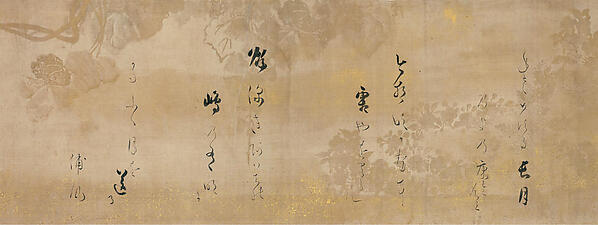
Waka poems from the Collection of Poems of a Thousand Years, Continued by Kojima Sōshin, The Metropolitan Museum of Art

Waka poems from the Collection of Poems of a Thousand Years, Continued

Kojima Sōshin (d. 1656)

1651 · Handscroll; ink on decorated silk with color and gold

Cleared · Public Domain

live
The MetSimilar
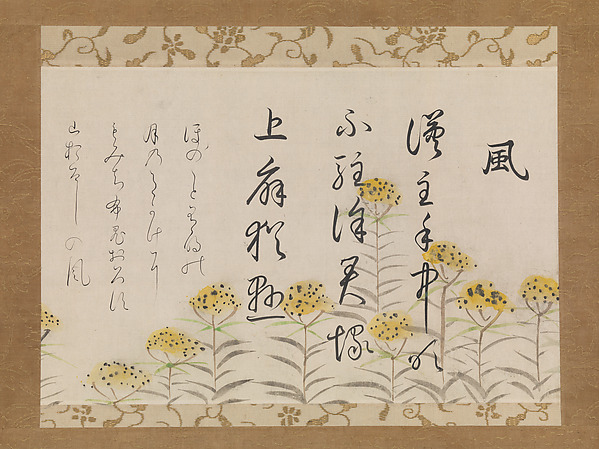
Poems on “Wind” from Japanese and Chinese and Poems to Sing by Horie Yorinao (Tōgen), The Metropolitan Museum of Art

Poems on “Wind” from Japanese and Chinese and Poems to Sing

Horie Yorinao (Tōgen) (d. 1693)

1670 · Hanging scroll; ink and color on paper

Cleared · Public Domain

live
The MetSimilar
Twelve Poems from the New Collection of Poems Ancient and Modern by Hon'ami Kōetsu, The Metropolitan Museum of Art

Twelve Poems from the New Collection of Poems Ancient and Modern

Hon'ami Kōetsu (d. 1637)

ca. 1620 · Handscroll; ink and gold on silk

Cleared · Public Domain

live
The MetSimilar
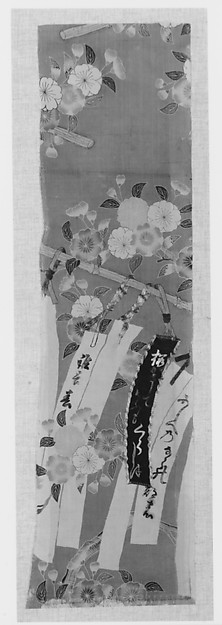
Piece from a Kosode with Cherry Blossoms and Poem Slips by an unrecorded maker, The Metropolitan Museum of Art

Piece from a Kosode with Cherry Blossoms and Poem Slips

Unrecorded maker

late 17th–early 18th century · Yūzen-dyed silk crepe (chirimen) with appliqué and embroidery in silk and metallic thread

Cleared · Public Domain

live
The MetSimilar
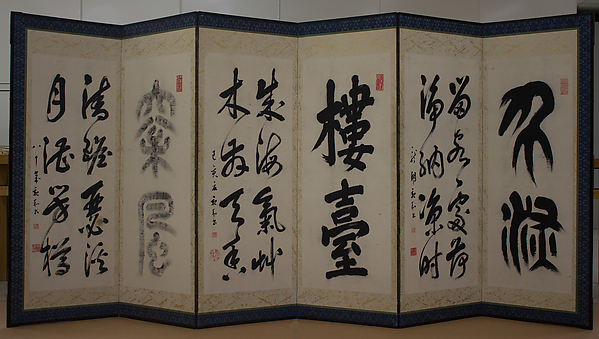
Chinese Poems and Calligraphy by Mitsui Shinna 三井親和, The Metropolitan Museum of Art

Chinese Poems and Calligraphy

Mitsui Shinna 三井親和 (d. 1782)

1779 · Six-panel folding screen; ink on paper

Cleared · Public Domain

live
The MetSimilar

1. Pin the work

Choose the record and say what you are actually going to do with it. The product re-reads the work live and stores a snapshot, so your docket records what the institution said today.

2. Read the arithmetic

Six weighted factors: the institution's own claim, the creator's term, the publication-age rule, the restrictions in their statement, your use, and whether a credit line is even possible.

3. Seal and export

Record the decision into a SHA-384 chain, then export a dated docket as JSON, CSV or Markdown with the credit line and the seal a colleague can re-verify.