Skip to content
OpenPlate

Rights clearance desk for images

A painting can be out of copyright and thephotograph of it can still be protected.

Museums publish two different things about the same artwork: whether the work is in copyright, and whether their picture of it is. OpenPlate reads both, does the arithmetic on the published term, and shows you the sentence behind every point of the score.

Where this page got its records

  • The Metlive

    322 ms. The Metropolitan Museum of Art, Collection API (Open Access)

  • Clevelandlive

    311 ms. The Cleveland Museum of Art, Open Access API

Your defaults

United States, editorial use, 10,000 reach.

Change on the terms page

2 of 2 providers answered live. 67 matching records exist across the two collections.

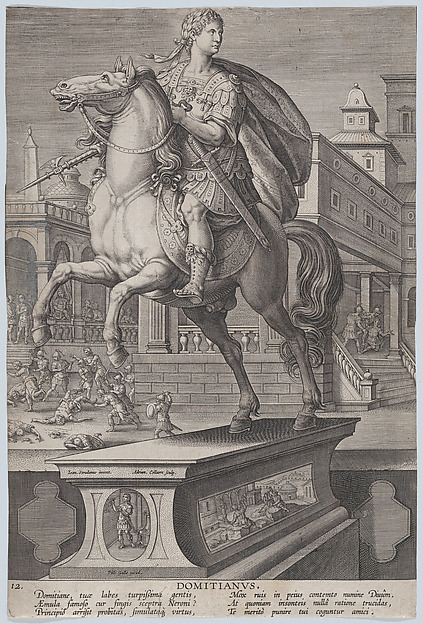
Results for "Plate 12: equestrian statue of Domitian,"12 records

Institutions answered newest-first by record, interleaved

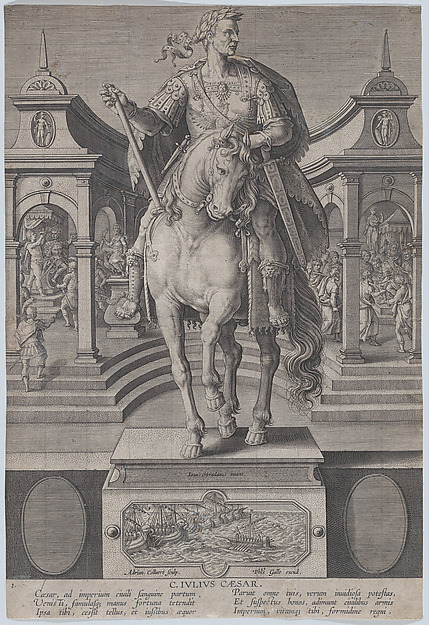
Plate 1: equestrian statue of Julius Caesar, seen from the front, with a scene of a naval battle on pedestal below, from 'Roman Emperors on Horseback' by Adriaen Collaert, The Metropolitan Museum of Art

Plate 1: equestrian statue of Julius Caesar, seen from the front, with a scene of a naval battle on pedestal below, from 'Roman Emperors on Horseback'

Adriaen Collaert (d. 1618)

ca. 1587–89 · Engraving; first state of two

Cleared · Public Domain

live
The MetSimilar
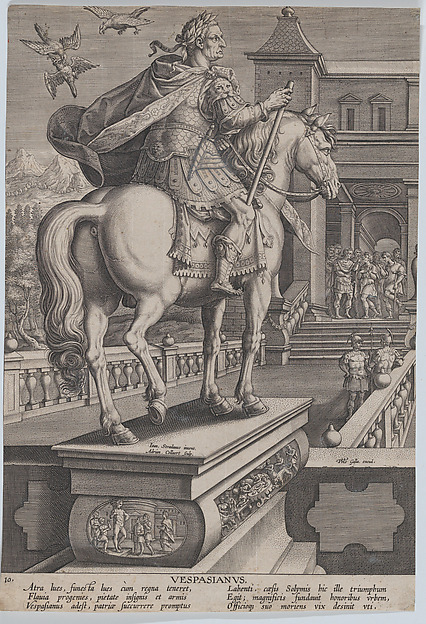
Plate 10: equestrian statue of Vespasian, seen from behind, three birds at upper right with one attacking another, from 'Roman Emperors on Horseback' by Adriaen Collaert, The Metropolitan Museum of Art

Plate 10: equestrian statue of Vespasian, seen from behind, three birds at upper right with one attacking another, from 'Roman Emperors on Horseback'

Adriaen Collaert (d. 1618)

ca. 1587–89 · Engraving

Cleared · Public Domain

live
The MetSimilar
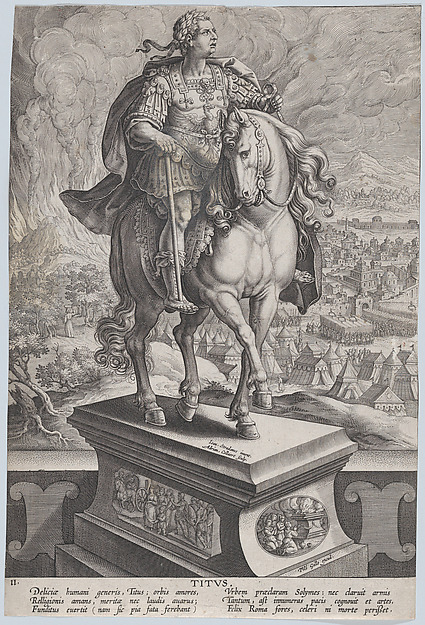
Plate 11: equestrian statue of Titus, seen three-quarters to the right, Mount Vesuvius erupting at left in the background, from 'Roman Emperors on Horseback' by Adriaen Collaert, The Metropolitan Museum of Art

Plate 11: equestrian statue of Titus, seen three-quarters to the right, Mount Vesuvius erupting at left in the background, from 'Roman Emperors on Horseback'

Adriaen Collaert (d. 1618)

ca. 1587–89 · Engraving

Cleared · Public Domain

live
The MetSimilar
Plate 12: equestrian statue of Domitian, seen three-quarters to the left, with his stabbing death at right in the background, from 'Roman Emperors on Horseback' by Adriaen Collaert, The Metropolitan Museum of Art

Plate 12: equestrian statue of Domitian, seen three-quarters to the left, with his stabbing death at right in the background, from 'Roman Emperors on Horseback'

Adriaen Collaert (d. 1618)

ca. 1587–89 · Engraving

Cleared · Public Domain

live
The MetSimilar
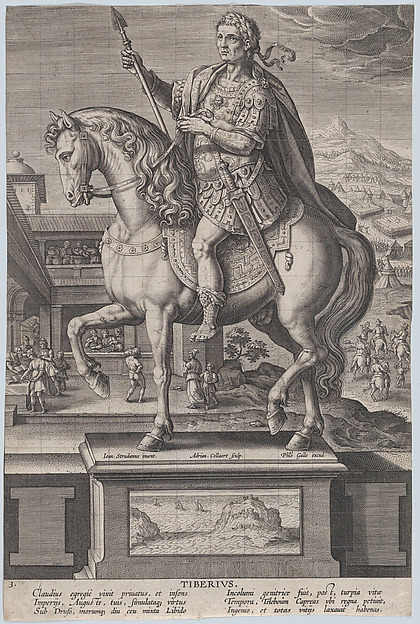
Plate 3: equestrian statue of Tiberius, in profile to the left, with a naval landscape on pedestal below, from 'Roman Emperors on Horseback' by Adriaen Collaert, The Metropolitan Museum of Art

Plate 3: equestrian statue of Tiberius, in profile to the left, with a naval landscape on pedestal below, from 'Roman Emperors on Horseback'

Adriaen Collaert (d. 1618)

ca. 1587–89 · Engraving, squared in graphite

Cleared · Public Domain

live
The MetSimilar
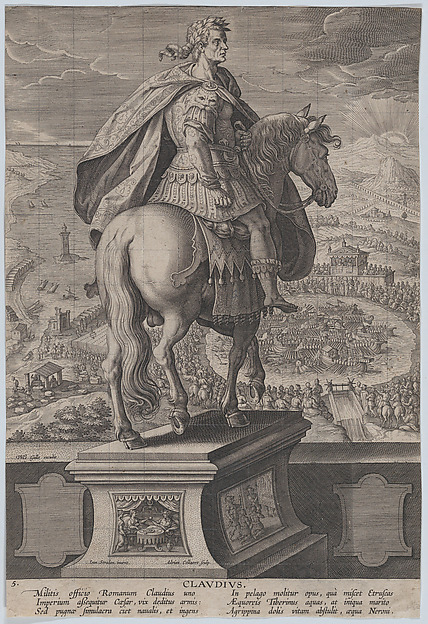
Plate 5: equestrian statue of Claudius, seen from behind, a naval competition at right in the background, from 'Roman Emperors on Horseback' by Adriaen Collaert, The Metropolitan Museum of Art

Plate 5: equestrian statue of Claudius, seen from behind, a naval competition at right in the background, from 'Roman Emperors on Horseback'

Adriaen Collaert (d. 1618)

ca. 1587–89 · Engraving, squared in graphite

Cleared · Public Domain

live
The MetSimilar
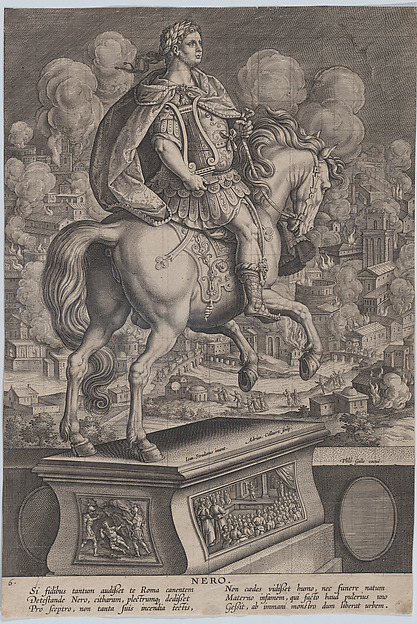
Plate 6: equestrian statue of Nero, seen from behind, the Great Fire of Rome in the background, from 'Roman Emperors on Horseback' by Adriaen Collaert, The Metropolitan Museum of Art

Plate 6: equestrian statue of Nero, seen from behind, the Great Fire of Rome in the background, from 'Roman Emperors on Horseback'

Adriaen Collaert (d. 1618)

ca. 1587–89 · Engraving, squared in graphite

Cleared · Public Domain

live
The MetSimilar
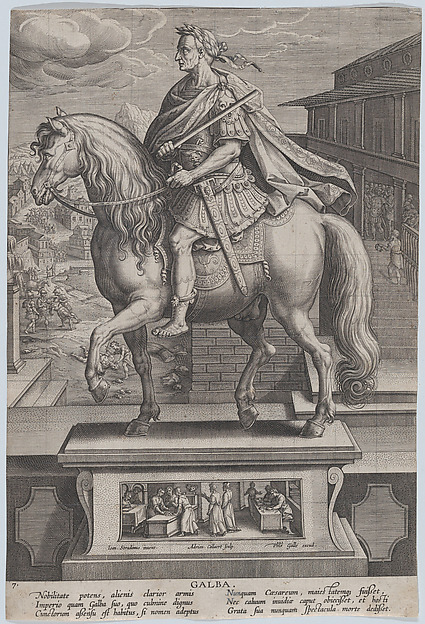
Plate 7: equestrian statue of Galba, in profile to the left, with a beheading scene in the background, from 'Roman Emperors on Horseback' by Adriaen Collaert, The Metropolitan Museum of Art

Plate 7: equestrian statue of Galba, in profile to the left, with a beheading scene in the background, from 'Roman Emperors on Horseback'

Adriaen Collaert (d. 1618)

ca. 1587–89 · Engraving, squared in graphite

Cleared · Public Domain

live
The MetSimilar
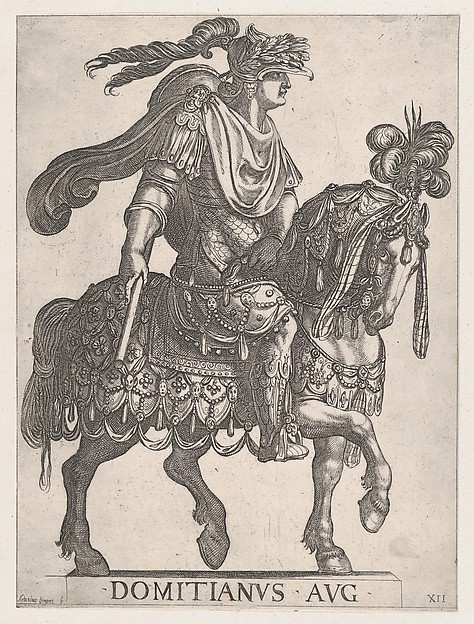
Plate 12: Emperor Domitian on horseback facing right, from "The First Twelve Emperors of Ancient Rome" by Antonio Tempesta, The Metropolitan Museum of Art

Plate 12: Emperor Domitian on horseback facing right, from "The First Twelve Emperors of Ancient Rome"

Antonio Tempesta (d. 1630)

1575–1630 · Etching

Cleared · Public Domain

live
The MetSimilar

No open reproduction

The institution withholds the image for this record, which is itself the answer: the picture on their page is not theirs to give away.

Equestrian statue of Marcus Aurelius in profile

Marcantonio Raimondi (d. 1534)

ca. 1500–1534 · Engraving; only state

In copyright

live
The MetSimilar

No open reproduction

The institution withholds the image for this record, which is itself the answer: the picture on their page is not theirs to give away.

Plate 12: Portrait of Domitian, from "The Emperors and Empresses of Rome"

Aegidius Sadeler II (d. 1629)

1597–1627 · Etching and engraving; second state of three (TIB)

In copyright

live
The MetSimilar

No open reproduction

The institution withholds the image for this record, which is itself the answer: the picture on their page is not theirs to give away.

Design for a Double Triumphal Arch with an Equestrian Statue Under a Pediment on the Upper Story, from Desseins d'Arc de Triomphe, part of Œuvres du Sr. D. Marot

Daniel Marot the Elder (d. 1752)

published 1703 or 1712 · Etching

In copyright

live
The MetSimilar

1. Pin the work

Choose the record and say what you are actually going to do with it. The product re-reads the work live and stores a snapshot, so your docket records what the institution said today.

2. Read the arithmetic

Six weighted factors: the institution's own claim, the creator's term, the publication-age rule, the restrictions in their statement, your use, and whether a credit line is even possible.

3. Seal and export

Record the decision into a SHA-384 chain, then export a dated docket as JSON, CSV or Markdown with the credit line and the seal a colleague can re-verify.