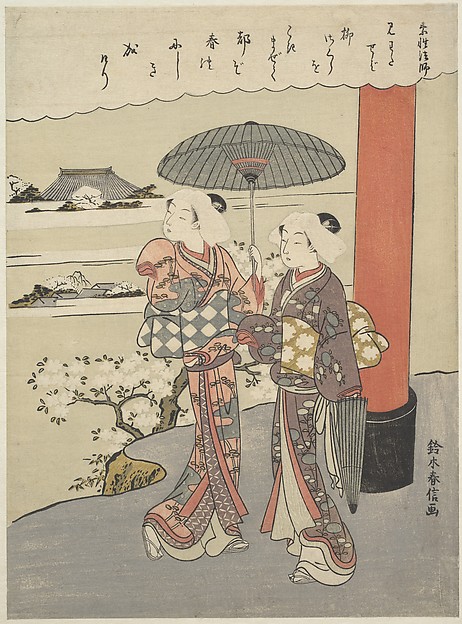
Poem by the Monk Sosei (act. 850-97)
Suzuki Harunobu (d. 1770)
ca. 1767–68 · Woodblock print; ink and color on paper, with embossing (karazuri)
Cleared · Public Domain
liveThe MetSimilar
Rights clearance desk for images
Museums publish two different things about the same artwork: whether the work is in copyright, and whether their picture of it is. OpenPlate reads both, does the arithmetic on the published term, and shows you the sentence behind every point of the score.
Where this page got its records
190 ms. The Metropolitan Museum of Art, Collection API (Open Access)
256 ms. The Cleveland Museum of Art, Open Access API
2 of 2 providers answered live. 10 matching records exist across the two collections.
Institutions answered newest-first by record, interleaved
Poem by the Monk Sosei (act. 850-97)
Suzuki Harunobu (d. 1770)
ca. 1767–68 · Woodblock print; ink and color on paper, with embossing (karazuri)
Cleared · Public Domain
liveNo open reproduction
The institution withholds the image for this record, which is itself the answer: the picture on their page is not theirs to give away.
Woman Dressing
Hashiguchi Goyō (d. 1921)
1920 · Woodblock print; ink, color, and mica on paper
In copyright
liveNo open reproduction
The institution withholds the image for this record, which is itself the answer: the picture on their page is not theirs to give away.
The Scent of Scarlet Flowers (Shuka funpō)
Kaburaki Kiyokata 鏑木清方 (d. 1972)
1922 · Two-panel folding screen; ink and color on silk; gold leaf applied on the reverse side (urahaku)
In copyright
liveNo open reproduction
The institution withholds the image for this record, which is itself the answer: the picture on their page is not theirs to give away.
Man’s Under-Kimono (Nagajuban) with Scene of the Russo-Japanese War featuring General Nogi
Unrecorded maker
early 20th century · Resist-dyed, hand-painted plain-weave silk with traces of gold leaf
In copyright
liveNo open reproduction
The institution withholds the image for this record, which is itself the answer: the picture on their page is not theirs to give away.
A Snowy Day
Takeuchi Meihō 竹内鳴鳳 (d. 1945)
1920s–30s · Hanging scroll; ink and color on silk
In copyright
liveNo open reproduction
The institution withholds the image for this record, which is itself the answer: the picture on their page is not theirs to give away.
Man's Under-kimono (Nagajuban) with Skeletons
Unrecorded maker
ca. 1930s · Plain-weave crepe silk with paste-resist dyeing
In copyright
liveNo open reproduction
The institution withholds the image for this record, which is itself the answer: the picture on their page is not theirs to give away.
Woman’s Under-Kimono (Nagajuban) with Piano Keys and Libretti from Two Songbooks
Unrecorded maker
ca. 1930s · Silk with printed design
In copyright
liveNo open reproduction
The institution withholds the image for this record, which is itself the answer: the picture on their page is not theirs to give away.
Man’s Under-Kimono (Nagajuban) with “Italy in Ethiopia” Symbols
Unrecorded maker
ca. 1935–45 · Plain-weave silk with printing
In copyright
liveNo open reproduction
The institution withholds the image for this record, which is itself the answer: the picture on their page is not theirs to give away.
Sake Cup (Sakazuki)
Tamako Kataoka (d. 2008)
early 1950s · Framed panel; ink, color, gold paint, gold and silver leaf on silk
In copyright
liveNo open reproduction
The institution withholds the image for this record, which is itself the answer: the picture on their page is not theirs to give away.
Man’s Under-Kimono (Nagajuban) with Cameras
Unrecorded maker
ca. 1955 · Silk with printed design
In copyright
live1. Pin the work
Choose the record and say what you are actually going to do with it. The product re-reads the work live and stores a snapshot, so your docket records what the institution said today.
2. Read the arithmetic
Six weighted factors: the institution's own claim, the creator's term, the publication-age rule, the restrictions in their statement, your use, and whether a credit line is even possible.
3. Seal and export
Record the decision into a SHA-384 chain, then export a dated docket as JSON, CSV or Markdown with the credit line and the seal a colleague can re-verify.